
? Key takeaways:
- A minimum order quantity (MOQ) is the smallest order a supplier, distributor, or wholesaler will accept from a customer. It ensures that every order generates enough revenue to cover fulfillment costs and contribute to profit.
- MOQs protect margins and improve operational efficiency. Without them, small orders can consume the same delivery, warehouse, and administrative resources as much larger orders, making otherwise healthy accounts unprofitable.
- The right MOQ is based on cost and demand data. Calculate your break-even point, factor in inventory carrying costs, and validate the threshold against actual customer ordering patterns. Then enforce it consistently at order entry to prevent margin leakage.
Picture this: a retail account places an order for eight cases of your product. Your sales rep accepts it, the warehouse picks it, and a driver makes the stop.
By the time you factor in the driver’s time, the route slot, the pick-and-pack labor, and the administrative processing, you’ve spent $55 fulfilling an order that earned you $40 in gross margin.
The order ships. The margin disappears. And across a dozen accounts running similar volumes, the same math plays out every week.
That’s the operational cost of having no minimum order quantity, or having one that nobody consistently enforces.
A minimum order quantity (MOQ) is one of the simplest margin-protection tools in wholesale distribution, yet it’s almost never enforced at the point of order entry, where it actually matters.
In this guide, we’ll cover what minimum order quantity is, why it exists, how to calculate it, and how distributors and CPG brands can use it as a strategic policy.
What is minimum order quantity?
A minimum order quantity (MOQ) is the smallest order a supplier, distributor, or wholesaler will accept from a customer in a single transaction. It defines the minimum number of units or minimum amount of product a buyer must commit to before an order is processed.
MOQs are expressed in one of two ways:
- Unit-based MOQ: A fixed number of units, cases, or pallets per order. Common where production cost scales directly with volume; for example, a beverage distributor requiring a minimum of 24 cases per delivery stop
- Value-based MOQ: A minimum dollar threshold per order regardless of product mix. More practical for wholesale distributors managing broad SKU catalogs, where a retailer might combine multiple product lines in a single order
Before going deeper into MOQs, let’s understand how it’s different from two related terms: MPQ and minimum spend.
A minimum purchase quantity (MPQ) sets a floor on the number of units a buyer must order for a specific SKU. It operates at the product level, not the order level. On the other hand, minimum spend works differently: instead of a unit count, it sets a dollar threshold the buyer’s total order must meet.
For supply chain teams at CPG brands and distributors, minimum order quantity works in two directions: you’re subject to your supplier’s minimum order quantity requirements when sourcing goods, and you’re setting your own MOQs for the retail accounts you serve.
Why do distributors set minimum order quantities?
Fixed costs per transaction
Every fulfillment event carries fixed costs regardless of order size.
For a distributor, that includes the route slot, driver time, warehouse labor, and administrative expenses tied to order processing and invoicing.
These costs don’t scale down with a smaller order. A $60 order and a $600 order absorb the same fixed cost per stop, which means the small order erodes margin in ways that don’t show up until you run the numbers.
Setting a minimum order ensures each transaction covers its own overhead.
Production schedules and raw material minimums
Manufacturers set MOQs because of upstream constraints.
Suppliers impose their own minimums to cover fixed production costs: equipment setup, tooling, and batch sizes below which a run stops making economic sense.
Raw materials compound this further. A manufacturer often has to buy a full batch of inputs regardless of how small the finished-goods order is, and that upstream cost flows directly into the MOQ they set downstream.
Distributors buying from manufacturers feel this pressure differently. When a supplier’s MOQ is 500 units, but your accounts can only absorb 50 units per cycle, you end up holding excess inventory and absorbing the carrying costs that come with it.
Profit margin protection
Per-unit cost falls as order volume rises. The supplier pays less for raw materials in larger quantities; the distributor pays less per unit when buying in bulk.
Volume discounts are built on this logic, and when a buyer meets the MOQ, those bulk savings can be passed through as better per-unit pricing. Without a minimum, the seller carries the cost of small-order economics while charging prices that only make sense at higher volumes.
How to calculate and set minimum order quantity?
There’s no universal minimum order quantity formula, but the underlying logic is consistent: your MOQ must sit above the break-even point where each order covers its costs and contributes to margin.
Here’s a four-step process:
Step 1: Calculate your total cost per order
Add up every cost tied to a single fulfillment event:
- Order processing and administrative costs (data entry, invoicing, payment handling)
- Pick-and-pack labor
- Drive time and route allocation for the stop
- Fuel and vehicle cost attributed to the delivery
- Returns or credit processing costs, averaged across your account base
Step 2: Find the break-even point
The break-even point is the order size at which revenue equals cost. For a unit-based MOQ:
Break-even quantity = Fixed costs per order ÷ (Unit selling price − Variable cost per unit)
For example:
- Fixed costs per delivery stop: $45
- Variable cost per unit: $8
- Selling price per unit: $14
- Break-even = $45 ÷ ($14 − $8) = 7.5 units
At 8 units, you cover costs but earn nothing. Your MOQ should sit above that threshold, let’s say 15 to 20 units, to ensure each order actually contributes to profit margin.
For value-based MOQs, the same logic applies: calculate the minimum order dollar value the stop needs to generate to be profitable, given your average margin across the SKU mix.
Step 3: Factor in inventory carrying costs
If you’re holding stock before it’s ordered, those inventory costs belong in the calculation.
Inventory carrying costs include storage costs, warehousing fees, insurance, and the opportunity cost of capital tied up in stock. Carrying costs hover around 20% to 30% of inventory value annually, though this varies by product type and shelf life.
High-turnover items can support a higher MOQ because stock cycles quickly.
Slower-moving products need a tighter minimum to avoid tying up working capital in stock that sits for extended periods.
Inventory forecasting helps here. If demand forecasts show a particular SKU moving 40 units per month across an account, your MOQ for that SKU should reflect that cycle rather than a generic threshold.
Inventory turnover is also a useful benchmark when reviewing MOQs over time. If a product’s turnover drops significantly, the MOQ needs to come down with it.
Step 4: Validate against actual demand
A break-even MOQ that your accounts can’t realistically meet will cost you the account.
Before finalizing any minimum, cross-reference your calculation against average order sizes across your existing customer base.
If your break-even is 20 units but the median account orders 12 units, you have options: adjust fulfillment costs, restructure pricing, or build a tiered structure that accommodates smaller accounts while maintaining a higher floor for established accounts.
Also read:
High MOQ vs. low MOQ: What are the trade-offs for distributors?
| Factors | High MOQ | Low MOQ |
| Per-unit cost | Lower (bulk savings) | Higher (smaller runs) |
| Inventory carrying costs | Higher for buyer | Lower for buyer |
| Operational efficiency | Fewer stops, larger orders | More stops, smaller orders |
| Cash flow impact | Larger upfront commitment | Smaller, more frequent payments |
| Account accessibility | Lower (excludes small buyers) | Higher (accessible to more accounts) |
| Administrative load | Lower (fewer transactions) | Higher (more orders to process) |
| Obsolescence risk | Higher (larger quantities committed) | Lower (smaller quantities per cycle) |
High MOQs work well for established, high-volume accounts, commodity CPG products, and categories where retail buyers expect to order in bulk.
A high minimum order quantity strengthens supply chain management efficiency by consolidating volume into fewer, larger transactions.
On the flip side, low MOQs suit specialty products, new market entries, and accounts that need flexibility to test performance before committing to volume.
A high MOQ can tie up significant working capital for buyers, in some cases tens of thousands of dollars per SKU per cycle, which becomes a barrier for smaller retailers. Low MOQs reduce that barrier but increase the seller’s administrative load and per-stop cost.
The stakes of miscalibrating either side are significant: IHL Group estimates that overstocks and out-of-stocks cost global retailers $1.73 trillion in 2024. To put that into perspective: the number is equivalent to South Korea’s entire GDP!
For distribution businesses serving a mixed account base, the practical answer is usually a tiered structure: a lower minimum for new accounts that steps up after 60 to 90 days. This balances acquisition and margin protection without applying the same friction to every relationship.
Common mistakes while setting minimum order quantity and how to avoid them
| Mistake | Why it hurts | How to fix it |
| Setting MOQ by gut, not data | Margin erosion on every under-priced order | Run the break-even calculation using actual per-stop costs |
| One MOQ for all accounts and SKUs | Too blunt for a mixed account base | Tier by account type; review by product category |
| No enforcement at order entry | Under-MOQ orders ship, eating into margin | Enforce at order confirmation, not at fulfillment |
| Set-and-forget MOQ | Costs shift; MOQ drifts out of alignment | Review quarterly alongside pricing and margin data |
Mistake 1: Setting MOQ based on intuition, not cost data
A $200 delivery minimum sounds reasonable until you calculate that your actual break-even is $280 once driver costs, admin overhead, and carrying costs are included.
Run the numbers before setting any threshold.
Mistake 2: Applying a flat MOQ across all accounts and products
A large grocery chain and an independent convenience store don’t have the same ordering capacity. Similarly, a fast-moving beverage SKU and a specialty condiment don’t carry the same margin profile.
A single MOQ applied uniformly will either be too low to protect margin on small accounts or too restrictive for new ones.
Build a tiered structure and review whether product-level minimums make sense for your highest- and lowest-margin lines separately.
Mistake 3: Failing to enforce at the point of ordering
A written policy that reps enforce inconsistently, or that the ordering system doesn’t validate automatically, is effectively no policy at all. Under-MOQ orders get accepted because a rep wants to keep the account happy, or because there’s no system flag to catch it.
By the time the impact shows up in reporting, hundreds of small orders have already shipped.
The fix is enforcement at order entry, before the commitment is made.
Mistake 4: Never revisiting MOQ as costs change
Fuel costs rise, and driver wages increase. Warehousing rates shift. An MOQ calibrated to last year’s fulfillment economics is eroding margin today.
Treat MOQ as a dynamic policy reviewed quarterly alongside pricing and margin data. It shouldn’t be a one-time setup.
MOQ enforcement starts with the right system
A minimum order quantity is only as effective as the system behind it.
The calculation tells you where to set the floor. The policy tells your team what to do. But neither protects margin if an under-MOQ order can still move through fulfillment without being caught.
For distributors managing multiple accounts, SKUs, and field reps, that’s where distribution management software closes the loop.
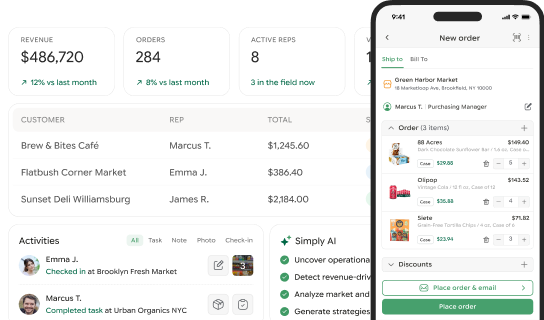
Use a platform like SimplyDepo that integrates orders, pricing, and fulfillment into a single platform, so reps work from accurate account-level parameters when placing orders in the field.
Inventory management is built into the same system, giving operations teams real-time visibility into stock levels and order activity across all routes and accounts.
If MOQ enforcement is a recurring problem in your operation, chances are, the process behind it needs refinement. Book a demo to see how SimplyDepo handles it.
FAQs on Minimum Order Quantity (MOQ)
What is the difference between MOQ and EOQ?
MOQ is the minimum a seller will accept per transaction. Economic order quantity (EOQ) is the optimal quantity a buyer should order to balance ordering costs against inventory holding costs. They operate from opposite sides of the supply chain. A supplier’s MOQ may diverge significantly from a buyer’s EOQ. When that happens, it creates negotiation friction and can lead to excess inventory on the buyer’s side.
How do you calculate minimum order quantity?
Calculate your fixed cost per order, find the break-even quantity using: break-even = fixed costs ÷ (selling price per unit − variable cost per unit), then set your MOQ above that threshold to ensure profitability. Validate the result against actual account order data before finalizing.
Should you set MOQ by units or by value?
Unit-based MOQs work well for narrow product ranges where volume directly determines production and fulfillment cost. Value-based MOQs are more practical for distributors with broad catalogs, where accounts mix SKUs and applying a per-unit floor would be difficult to calculate and communicate consistently.
What happens if a customer doesn't meet the MOQ?
Common options: decline the order, apply a small-order surcharge to offset the margin impact, or allow documented exceptions for strategic accounts. Whichever policy you choose, communicate it clearly at account setup and enforce it consistently. Ad-hoc exceptions are the fastest way to erode the policy entirely.
Can you negotiate MOQ with your suppliers?
Yes. Useful approaches include splitting a large order across multiple delivery windows, consolidating your SKU mix under a single value-based minimum, offering volume commitments over a defined period in exchange for a lower per-order floor, or sourcing through a distributor who already meets the manufacturer’s MOQ. Long-term supplier relationships tend to create more flexibility on these terms over time.


You shouldn't need 5 tools to run distribution.

You shouldn't need 5 tools to run distribution.



Boost Sales.
Cut Manual Work.
Streamline ordering, routing and retail execution — while giving every rep the tools to grow accounts faster.
-
+15h
Save weekly
per rep -
93%
Increase
buyer retention -
24%
Increase
in retail sales

Let's connect!
Error: Contact form not found.
Error: Contact form not found.